


About The Report
E-passport Market Analysis and Forecast 2026 to 2036
The next decade of e-passport growth is being shaped less by incremental booklet upgrades and more by how states operationalize trust at scale across issuance and border decisioning. When cryptographic verification is wired into throughput economics, the value created is measurable: queue compression, lower exception handling, and fewer manual adjudications in high-volume corridors. That is why the market expands faster than underlying travel demand alone.
National issuance systems are being refactored so chips, keys, and personalization can be produced and audited at higher cadence. India’s publicly stated direction under Passport Seva Programme V2.0 is explicit that e-passport issuance is being phased into mainstream delivery, shifting demand from pilots to sustained volume. Interoperability is reinforced through ICAO’s eMRTD specifications and trust distribution through the ICAO Public Key Directory (PKD), which underpins cross-border authentication of certificates used to validate chip data. Third, border authorities and airports are aligning around identity-driven facilitation models, where the passport credential is expected to work consistently across e-gates and inspection devices, raising the premium on standards-aligned security mechanisms.
This directional change is increasingly described as a proven operating model rather than a vision deck. Nick Careen, IATA’s Senior Vice President for Operations, Safety and Security, stated: “A seamless fully digital travel experience powered by digital identity and biometrics has moved from theory to proven reality.”
Quick Stats for the Global E-passport Market
- Expected Value of the Global E-passport Market (2026): USD 86.2 billion
- Projected Value of the Global E-passport Market (2036): USD 593.0 billion
- Forecast CAGR for the E-passport Market (2026 to 2036): 21.3%
- Leading Solution Segment: RFID E-passport Chip (41.0%)
- Leading Application Segment: Leisure Travel (67.0%)
- Leading Security Segment: PACE (55.0%)
- Key Companies Profiled: Thales Group, IDEMIA, Entrust Corporation, Veridos GmbH, HID Global, Infineon Technologies AG, Gemalto (A Thales Company), De La Rue plc, Oberthur Technologies, Giesecke+Devrient (G+D)
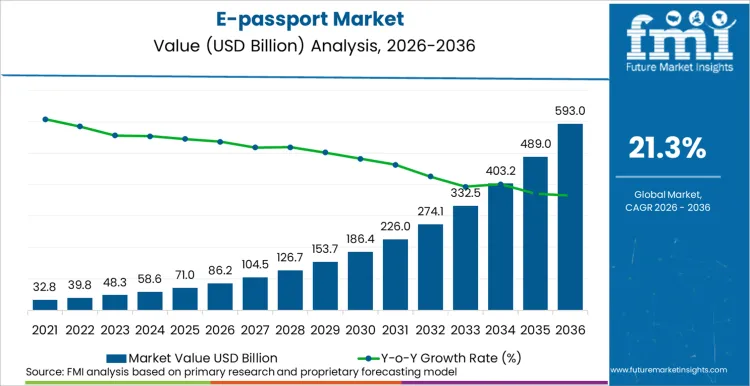
Global E-passport Market Key Takeaways
| Metric | Value |
|---|---|
| E-passport Market Size (2026E) | USD 86.2 billion |
| E-passport Market Value (2036F) | USD 593.0 billion |
| CAGR (2026-2036) | 21.3% |
How is the E-passport Market Growing?
E-passports are scaling because identity assurance is being industrialized across the travel journey. Growth is being pulled by the system effect created when issuance modernization, border automation, and interoperability standards land together.
A concrete policy lever is that e-passport possession is now embedded into facilitation access. The U.S. Visa Waiver Program explicitly requires an ICAO-compliant e-passport, which structurally ties adoption to high-volume leisure corridors rather than to niche high-security traveler cohorts. Japan’s visa exemption conditions for select nationalities similarly reference ICAO-compliant e-passports, reinforcing that compliance is an eligibility requirement.
On standards and trust distribution, ICAO Doc 9303 continues to anchor consistent data structures and access-control expectations, while ICAO PKD provides the mechanism for cross-border certificate validation used in eMRTD authentication. ICAO’s Digital Travel Credential guidance further signals that the passport remains the root credential even as processes become more digital and pre-travel.
How is the E-passport Market Segmented?
Why do RFID E-passport Chips lead Solution adoption?
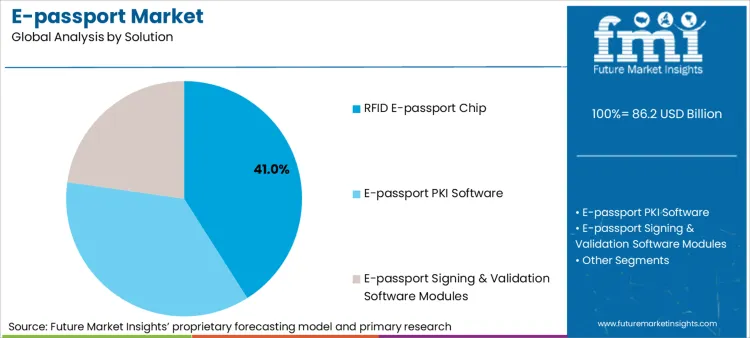
RFID e-passport chips account for 41.0% of solution adoption because they are the non-substitutable anchor of the entire eMRTD stack that include identity binding, inspection, and cryptographic integrity checks only work when the credential payload is stored and protected on-chip in an ICAO-aligned structure.
Once countries modernize inspection lanes (e-gates, automated readers, and higher-volume document examination), the chip becomes tightly coupled to throughput design: faster, more standardized inspection depends on machine-verifiable data and signature validation rather than manual, visually adjudicated checks.
Because the ICAO eMRTD model prescribes how the chip-based data is structured and verified, procurement decisions tend to treat chip capability as a baseline compliance requirement rather than a feature layer.
Why does Leisure Travel lead Application share?
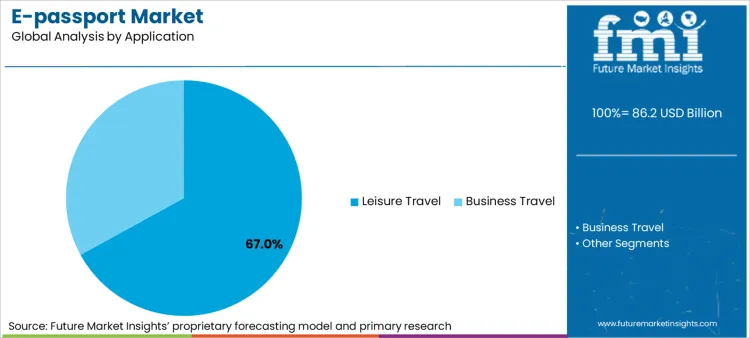
Leisure travel holds 67.0% of application share because adoption is increasingly driven by eligibility rules and border-processing design, not traveler preference. In the United States, participation in the Visa Waiver Program explicitly requires an e-passport which channels high-volume short-stay tourism flows into compliance-linked demand for chip-enabled passports.
Japan similarly ties visa-free or simplified entry conditions for specific nationalities and arrangements to holding an ICAO-compliant e-passport, effectively converting a large share of short-term leisure movement into a document-specification requirement. This mechanism matters for market mix because leisure trips are typically more frequent, higher-volume, and more policy-exposed than long-duration business or residency categories, so when a destination conditions easy entry on e-passport compliance, leisure demand becomes the dominant adoption engine.
Why does PACE lead Security adoption in the E-passport Landscape?
Password authenticated connection establishment (PACE) represents 55.0% of security adoption because it directly addresses access control expectations that become non-negotiable as contactless inspection scales across e-gates and mobile and handheld readers. Practically, PACE upgrades the open the chip securely step. It establishes a protected session based on a password derived from document data, which is central to preventing trivial skimming/unauthorized reads in scaled deployments.
ICAO Doc 9303 treats PACE as a deployable access-control mechanism within the eMRTD security architecture including how the chip and inspection system use document-derived secrets to bootstrap secure messaging, which accelerates standardization where inspection modernization programs are underway. As more checkpoints depend on automated, repeatable contactless reads, PACE adoption rises because it is increasingly “built into” interoperability expectations for secure, high-throughput inspection rather than treated as an optional security add-on.
Which Dynamics Influence Developments in the E-passport Landscape?
| Operational and Supply-Side Trigger | Impact |
|---|---|
| Issuance stack modernization moving from pilots to default issuance | India’s PSP V2.0 direction and parliamentary confirmation of phased e-passport rollout expands steady-state volumes for chips and personalization systems rather than episodic batches. |
| Trust distribution becoming an availability requirement (not an IT feature) | ICAO PKD institutionalizes certificate exchange for authentication, increasing the premium on vendors that can operate PKI lifecycle management with audit-ready uptime. |
| Facilitation rules converting compliance into demand | The U.S. VWP makes e-passports a prerequisite for streamlined entry, structurally weighting demand toward leisure-heavy corridors. |
Source: FMI’s proprietary forecasting model and primary research
Country-wise Analysis
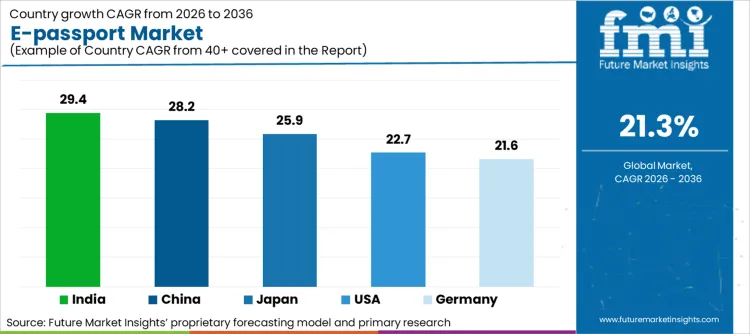
| Country | CAGR (2026-2036) |
|---|---|
| India | 29.4% |
| China | 28.2% |
| Japan | 25.9% |
| USA | 22.7% |
| Germany | 21.6% |
Source: Future Market Insights (FMI) analysis, based on proprietary forecasting model and primary research
How is India’s Expansion being shaped by issuance-scale redesign rather than “feature upgrades”?
India’s 29.4% CAGR is being driven by the conversion of e-passports from an initiative into a production operating model. The demand signal is not speculative: official statements around Passport Seva Programme V2.0 and parliamentary responses on e-passport issuance position roll-out as a staged national program.
That framing matters commercially because it implies recurring volumes across personalization, chip supply, and verification infrastructure, plus the service layers required to keep issuance SLAs intact across a high-footfall network of passport offices.
Why does China’s Expansion reflect scale-through-standardization economics in credential issuance?
China’s 28.2% CAGR aligns with a model where embedded-chip passports are treated as a standardized national credential rather than a premium variant, which supports high-volume issuance economics and sustained replenishment cycles.
Official passport information emphasizes the e-passport format and booklet standards as the norm of issuance rather than a niche track. In this setup, the market’s growth is shaped by the continuity of standardized issuance and the downstream need to keep inspection compatibility tight in cross-border contexts aligned to ICAO eMRTD specifications.
How is Japan’s Growth being pulled by facilitation eligibility and corridor design?
Japan’s 25.9% CAGR is being pulled by facilitation rules that convert e-passport ownership into a practical requirement for certain traveler cohorts. Japan’s visa exemption conditions for select nationalities explicitly reference the need for an ICAO-compliant e-passport, which links credential compliance directly to demand in leisure and short-stay travel flows. That policy structure effectively shifts e-passport demand from security modernization into access enablement, which is a stronger and more persistent driver in high-volume routes.
Why does the USA’s Growth track policy-gated demand plus passport product refresh cycles?
The USA’s 22.7% CAGR is anchored by policy-gated demand through the Visa Waiver Program, where an ICAO-compliant e-passport is a stated requirement. In parallel, the United States continues to modernize the passport booklet itself through next-generation passport upgrades, which sustains a refresh cadence that matters for materials, secure printing, and production operations. The combination is commercially decisive: one lever stabilizes baseline volumes, while the other sustains replacement and upgrade cycles.
How is Germany’s Market shaped by mature baseline, higher security expectations Dynamics?
Germany’s 21.6% CAGR is shaped by a mature ePass baseline that normalizes contactless chip identity documents and raises the bar for security mechanisms and verification discipline. Germany’s national cybersecurity authority (BSI) positions the ePass as a contactless-chip identity document, reflecting institutional maturity in how the credential is governed and used. In mature environments like this, growth is less about first-time adoption and more about lifecycle-driven upgrades, tightening access control, reader compatibility, and certificate handling aligned with the ICAO trust ecosystem.
Competitive Landscape
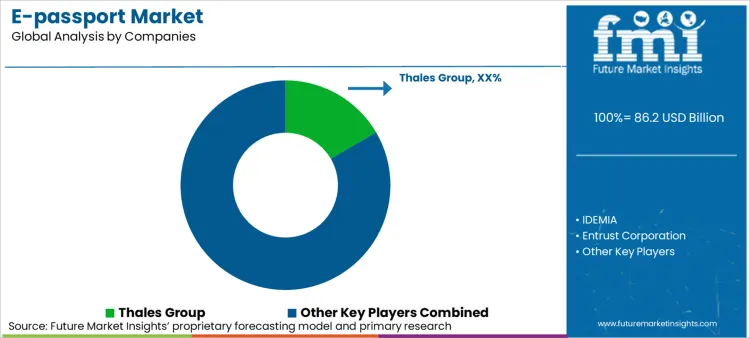
Competition is separating into three defensible arenas: issuance and personalization at national scale, cryptographic trust operations, and inspection ecosystem integration.
- Scale-grade issuance and personalization: Leadership is defined by the ability to run national programs as high-availability public services—predictable throughput, low defect rates, and tight materials governance across secure printing, chips, and personalization. This is where Thales, IDEMIA, Veridos, G+D, De La Rue, and Oberthur are evaluated: execution resilience, not marketing claims.
- Trust infrastructure as a switching cost: PKI lifecycle management increasingly determines stickiness, because certificate updates, revocation handling, and PKD participation become operational-risk items, not “IT features.” ICAO’s PKD role as a central trust repository makes the direction explicit. Entrust is structurally advantaged where auditability and lifecycle governance are decisive buying criteria.
- Border ecosystem attach: HID and inspection-side providers benefit as adoption shifts from issuance to utilization at e-gates and inspection points. The more a country invests in automated clearance, the more value shifts toward reader compatibility and update cadence aligned with Doc 9303 evolution.
Key Players Profiled
- Thales Group
- IDEMIA
- Entrust Corporation
- Veridos GmbH
- HID Global
- Infineon Technologies AG
- Gemalto (A Thales Company)
- De La Rue plc
- Oberthur Technologies
- Giesecke+Devrient (G+D)
Scope of Report
| Items | Values |
|---|---|
| Quantitative Units | USD Billion |
| Solution | RFID E-passport Chip; E-passport PKI Software; E-passport Signing & Validation Software Modules |
| Application | Leisure Travel; Business Travel |
| Security | Password Authenticated Connection Establishment; Basic Access Control; Supplemental Access Control; Extended Access Control |
| Key Countries Covered | India; China; Germany; Japan; USA |
| Key Companies Profiled | Thales Group; IDEMIA; Entrust Corporation; Veridos GmbH; HID Global; Infineon Technologies AG; Gemalto (A Thales Company); De La Rue plc; Oberthur Technologies; Giesecke+Devrient (G+D) |
E-passport Market by Key Segments
By Solution
- RFID E-passport Chip
- E-passport PKI Software
- E-passport Signing & Validation Software Modules
By Application
- Leisure Travel
- Business Travel
By Security
- Password Authenticated Connection Establishment
- Basic Access Control
- Supplemental Access Control
- Extended Access Control
By Region
- North America
- Latin America
- Western Europe
- Eastern Europe
- East Asia
- South Asia & Pacific
- Middle East & Africa
Bibliography
- International Civil Aviation Organization. (2024). Doc 9303, Part 11: Security mechanisms for MRTDs (consolidated ed.) [PDF]. International Civil Aviation Organization.
- International Civil Aviation Organization. (2024). High-level guidance: Explaining the ICAO Digital Travel Credentials (Version 1.0) [PDF]. ICAO TAG/TRIP.
- International Civil Aviation Organization. (n.d.). ICAO Public Key Directory (PKD). International Civil Aviation Organization.
- International Air Transport Association. (2024). Digital identity and biometrics for seamless travel (Nick Careen quote). International Air Transport Association.
- Ministry of External Affairs, Government of India. (2024, December 6). QUESTION NO. 1876: Issuance of e-Passports [Parliament reply].
- Bundesamt für Sicherheit in der Informationstechnik. (n.d.). Electronic passport (ePass). Federal Office for Information Security (Germany).
Frequently Asked Questions
How big is the global e-passport market?
The e-passport market is valued at USD 86.2 billion in 2026 and is projected to reach USD 593.0 billion by 2036.
What is the growth outlook over the next 10 years?
The market is forecast to expand at a 21.3% CAGR from 2026 to 2036.
Which applications drive demand?
Demand is led by leisure travel (67.0% share) as e-passport compliance becomes embedded in facilitation eligibility rules.
How does demand differ by region or industrial maturity?
India and China scale issuance capacity; Japan and the USA are pulled by facilitation policy; Germany’s growth is lifecycle-driven in a mature security baseline.
What are the main adoption or investment constraints?
Constraints center on issuance-system modernization, PKI operations maturity, and interoperability execution across border agencies.
Who are the leading solution providers, and how is leadership defined?
Key providers include Thales, IDEMIA, Entrust, Veridos, G+D, De La Rue, Oberthur, HID, and Infineon; leadership is defined by national-scale delivery reliability, cryptographic trust operations, and inspection ecosystem compatibility.
How do security or standards impact this market?
ICAO Doc 9303 and PKD participation shape which security mechanisms (including PACE) are deployable at scale and interoperable across borders.
Table of Content
- Executive Summary
- Global Market Outlook
- Demand to side Trends
- Supply to side Trends
- Technology Roadmap Analysis
- Analysis and Recommendations
- Market Overview
- Market Coverage / Taxonomy
- Market Definition / Scope / Limitations
- Research Methodology
- Chapter Orientation
- Analytical Lens and Working Hypotheses
- Market Structure, Signals, and Trend Drivers
- Benchmarking and Cross-market Comparability
- Market Sizing, Forecasting, and Opportunity Mapping
- Research Design and Evidence Framework
- Desk Research Programme (Secondary Evidence)
- Company Annual and Sustainability Reports
- Peer-reviewed Journals and Academic Literature
- Corporate Websites, Product Literature, and Technical Notes
- Earnings Decks and Investor Briefings
- Statutory Filings and Regulatory Disclosures
- Technical White Papers and Standards Notes
- Trade Journals, Industry Magazines, and Analyst Briefs
- Conference Proceedings, Webinars, and Seminar Materials
- Government Statistics Portals and Public Data Releases
- Press Releases and Reputable Media Coverage
- Specialist Newsletters and Curated Briefings
- Sector Databases and Reference Repositories
- Roots Internal Knowledge Base and Historical Datasets
- Subscription Datasets and Paid Sources
- Social Channels, Communities, and Digital Listening Inputs
- Additional Desk Sources
- Expert Input and Fieldwork (Primary Evidence)
- Primary Modes
- Qualitative Interviews and Expert Elicitation
- Quantitative Surveys and Structured Data Capture
- Blended A8oach
- Why Primary Evidence is Used
- Field Techniques
- Interviews
- Surveys
- Focus Groups
- Observational and In-context Research
- Social and Community Interactions
- Stakeholder Universe Engaged
- C-suite Leaders
- Board Members
- Presidents and Vice Presidents
- R&D and Innovation Heads
- Technical Specialists
- Domain Subject-matter Experts
- Scientists
- Physicians and Other Healthcare Professionals
- Governance, Ethics, and Data Stewardship
- Research Ethics
- Data Integrity and Handling
- Primary Modes
- Tooling, Models, and Reference Databases
- Desk Research Programme (Secondary Evidence)
- Data Engineering and Model Build
- Data Acquisition and Ingestion
- Cleaning, Normalisation, and Verification
- Synthesis, Triangulation, and Analysis
- Quality Assurance and Audit Trail
- Market Background
- Market Dynamics
- Drivers
- Restraints
- Opportunity
- Trends
- Scenario Forecast
- Demand in Optimistic Scenario
- Demand in Likely Scenario
- Demand in Conservative Scenario
- Opportunity Map Analysis
- Product Life Cycle Analysis
- Supply Chain Analysis
- Investment Feasibility Matrix
- Value Chain Analysis
- PESTLE and Porter’s Analysis
- Regulatory Landscape
- Regional Parent Market Outlook
- Production and Consumption Statistics
- Import and Export Statistics
- Market Dynamics
- Global Market Analysis 2021 to 2025 and Forecast, 2026 to 2036
- Historical Market Size Value (USD Million) Analysis, 2021 to 2025
- Current and Future Market Size Value (USD Million) Projections, 2026 to 2036
- Y to o to Y Growth Trend Analysis
- Absolute $ Opportunity Analysis
- Global Market Pricing Analysis 2021 to 2025 and Forecast 2026 to 2036
- Global Market Analysis 2021 to 2025 and Forecast 2026 to 2036, By Solution
- Introduction / Key Findings
- Historical Market Size Value (USD Million) Analysis By Solution , 2021 to 2025
- Current and Future Market Size Value (USD Million) Analysis and Forecast By Solution , 2026 to 2036
- RFID E-passport Chip
- E-passport PKI Software
- E-passport Signing & Validation Software Modules
- RFID E-passport Chip
- Y to o to Y Growth Trend Analysis By Solution , 2021 to 2025
- Absolute $ Opportunity Analysis By Solution , 2026 to 2036
- Global Market Analysis 2021 to 2025 and Forecast 2026 to 2036, By Application
- Introduction / Key Findings
- Historical Market Size Value (USD Million) Analysis By Application, 2021 to 2025
- Current and Future Market Size Value (USD Million) Analysis and Forecast By Application, 2026 to 2036
- Leisure Travel
- Business Travel
- Leisure Travel
- Y to o to Y Growth Trend Analysis By Application, 2021 to 2025
- Absolute $ Opportunity Analysis By Application, 2026 to 2036
- Global Market Analysis 2021 to 2025 and Forecast 2026 to 2036, By Security
- Introduction / Key Findings
- Historical Market Size Value (USD Million) Analysis By Security, 2021 to 2025
- Current and Future Market Size Value (USD Million) Analysis and Forecast By Security, 2026 to 2036
- Password Authenticated Connection Establishment
- Basic Access Control
- Supplemental Access Control
- Extended Access Control
- Password Authenticated Connection Establishment
- Y to o to Y Growth Trend Analysis By Security, 2021 to 2025
- Absolute $ Opportunity Analysis By Security, 2026 to 2036
- Global Market Analysis 2021 to 2025 and Forecast 2026 to 2036, By Region
- Introduction
- Historical Market Size Value (USD Million) Analysis By Region, 2021 to 2025
- Current Market Size Value (USD Million) Analysis and Forecast By Region, 2026 to 2036
- North America
- Latin America
- Western Europe
- Eastern Europe
- East Asia
- South Asia and Pacific
- Middle East & Africa
- Market Attractiveness Analysis By Region
- North America Market Analysis 2021 to 2025 and Forecast 2026 to 2036, By Country
- Historical Market Size Value (USD Million) Trend Analysis By Market Taxonomy, 2021 to 2025
- Market Size Value (USD Million) Forecast By Market Taxonomy, 2026 to 2036
- By Country
- USA
- Canada
- Mexico
- By Solution
- By Application
- By Security
- By Country
- Market Attractiveness Analysis
- By Country
- By Solution
- By Application
- By Security
- Key Takeaways
- Latin America Market Analysis 2021 to 2025 and Forecast 2026 to 2036, By Country
- Historical Market Size Value (USD Million) Trend Analysis By Market Taxonomy, 2021 to 2025
- Market Size Value (USD Million) Forecast By Market Taxonomy, 2026 to 2036
- By Country
- Brazil
- Chile
- Rest of Latin America
- By Solution
- By Application
- By Security
- By Country
- Market Attractiveness Analysis
- By Country
- By Solution
- By Application
- By Security
- Key Takeaways
- Western Europe Market Analysis 2021 to 2025 and Forecast 2026 to 2036, By Country
- Historical Market Size Value (USD Million) Trend Analysis By Market Taxonomy, 2021 to 2025
- Market Size Value (USD Million) Forecast By Market Taxonomy, 2026 to 2036
- By Country
- Germany
- UK
- Italy
- Spain
- France
- Nordic
- BENELUX
- Rest of Western Europe
- By Solution
- By Application
- By Security
- By Country
- Market Attractiveness Analysis
- By Country
- By Solution
- By Application
- By Security
- Key Takeaways
- Eastern Europe Market Analysis 2021 to 2025 and Forecast 2026 to 2036, By Country
- Historical Market Size Value (USD Million) Trend Analysis By Market Taxonomy, 2021 to 2025
- Market Size Value (USD Million) Forecast By Market Taxonomy, 2026 to 2036
- By Country
- Russia
- Poland
- Hungary
- Balkan & Baltic
- Rest of Eastern Europe
- By Solution
- By Application
- By Security
- By Country
- Market Attractiveness Analysis
- By Country
- By Solution
- By Application
- By Security
- Key Takeaways
- East Asia Market Analysis 2021 to 2025 and Forecast 2026 to 2036, By Country
- Historical Market Size Value (USD Million) Trend Analysis By Market Taxonomy, 2021 to 2025
- Market Size Value (USD Million) Forecast By Market Taxonomy, 2026 to 2036
- By Country
- China
- Japan
- South Korea
- By Solution
- By Application
- By Security
- By Country
- Market Attractiveness Analysis
- By Country
- By Solution
- By Application
- By Security
- Key Takeaways
- South Asia and Pacific Market Analysis 2021 to 2025 and Forecast 2026 to 2036, By Country
- Historical Market Size Value (USD Million) Trend Analysis By Market Taxonomy, 2021 to 2025
- Market Size Value (USD Million) Forecast By Market Taxonomy, 2026 to 2036
- By Country
- India
- ASEAN
- Australia & New Zealand
- Rest of South Asia and Pacific
- By Solution
- By Application
- By Security
- By Country
- Market Attractiveness Analysis
- By Country
- By Solution
- By Application
- By Security
- Key Takeaways
- Middle East & Africa Market Analysis 2021 to 2025 and Forecast 2026 to 2036, By Country
- Historical Market Size Value (USD Million) Trend Analysis By Market Taxonomy, 2021 to 2025
- Market Size Value (USD Million) Forecast By Market Taxonomy, 2026 to 2036
- By Country
- Kingdom of Saudi Arabia
- Other GCC Countries
- Turkiye
- South Africa
- Other African Union
- Rest of Middle East & Africa
- By Solution
- By Application
- By Security
- By Country
- Market Attractiveness Analysis
- By Country
- By Solution
- By Application
- By Security
- Key Takeaways
- Key Countries Market Analysis
- USA
- Pricing Analysis
- Market Share Analysis, 2025
- By Solution
- By Application
- By Security
- Canada
- Pricing Analysis
- Market Share Analysis, 2025
- By Solution
- By Application
- By Security
- Mexico
- Pricing Analysis
- Market Share Analysis, 2025
- By Solution
- By Application
- By Security
- Brazil
- Pricing Analysis
- Market Share Analysis, 2025
- By Solution
- By Application
- By Security
- Chile
- Pricing Analysis
- Market Share Analysis, 2025
- By Solution
- By Application
- By Security
- Germany
- Pricing Analysis
- Market Share Analysis, 2025
- By Solution
- By Application
- By Security
- UK
- Pricing Analysis
- Market Share Analysis, 2025
- By Solution
- By Application
- By Security
- Italy
- Pricing Analysis
- Market Share Analysis, 2025
- By Solution
- By Application
- By Security
- Spain
- Pricing Analysis
- Market Share Analysis, 2025
- By Solution
- By Application
- By Security
- France
- Pricing Analysis
- Market Share Analysis, 2025
- By Solution
- By Application
- By Security
- India
- Pricing Analysis
- Market Share Analysis, 2025
- By Solution
- By Application
- By Security
- ASEAN
- Pricing Analysis
- Market Share Analysis, 2025
- By Solution
- By Application
- By Security
- Australia & New Zealand
- Pricing Analysis
- Market Share Analysis, 2025
- By Solution
- By Application
- By Security
- China
- Pricing Analysis
- Market Share Analysis, 2025
- By Solution
- By Application
- By Security
- Japan
- Pricing Analysis
- Market Share Analysis, 2025
- By Solution
- By Application
- By Security
- South Korea
- Pricing Analysis
- Market Share Analysis, 2025
- By Solution
- By Application
- By Security
- Russia
- Pricing Analysis
- Market Share Analysis, 2025
- By Solution
- By Application
- By Security
- Poland
- Pricing Analysis
- Market Share Analysis, 2025
- By Solution
- By Application
- By Security
- Hungary
- Pricing Analysis
- Market Share Analysis, 2025
- By Solution
- By Application
- By Security
- Kingdom of Saudi Arabia
- Pricing Analysis
- Market Share Analysis, 2025
- By Solution
- By Application
- By Security
- Turkiye
- Pricing Analysis
- Market Share Analysis, 2025
- By Solution
- By Application
- By Security
- South Africa
- Pricing Analysis
- Market Share Analysis, 2025
- By Solution
- By Application
- By Security
- USA
- Market Structure Analysis
- Competition Dashboard
- Competition Benchmarking
- Market Share Analysis of Top Players
- By Regional
- By Solution
- By Application
- By Security
- Competition Analysis
- Competition Deep Dive
- Thales Group
- Overview
- Product Portfolio
- Profitability by Market Segments (Product/Age /Sales Channel/Region)
- Sales Footprint
- Strategy Overview
- Marketing Strategy
- Product Strategy
- Channel Strategy
- IDEMIA
- Entrust Corporation
- Veridos GmbH
- HID Global
- Infineon Technologies AG
- Gemalto (A Thales Company)
- De La Rue plc
- Oberthur Technologies
- Giesecke+Devrient (G+D)
- Thales Group
- Competition Deep Dive
- Assumptions & Acronyms Used
List of Tables
- Table 1: Global Market Value (USD Million) Forecast by Region, 2021 to 2036
- Table 2: Global Market Value (USD Million) Forecast by Solution , 2021 to 2036
- Table 3: Global Market Value (USD Million) Forecast by Application, 2021 to 2036
- Table 4: Global Market Value (USD Million) Forecast by Security, 2021 to 2036
- Table 5: North America Market Value (USD Million) Forecast by Country, 2021 to 2036
- Table 6: North America Market Value (USD Million) Forecast by Solution , 2021 to 2036
- Table 7: North America Market Value (USD Million) Forecast by Application, 2021 to 2036
- Table 8: North America Market Value (USD Million) Forecast by Security, 2021 to 2036
- Table 9: Latin America Market Value (USD Million) Forecast by Country, 2021 to 2036
- Table 10: Latin America Market Value (USD Million) Forecast by Solution , 2021 to 2036
- Table 11: Latin America Market Value (USD Million) Forecast by Application, 2021 to 2036
- Table 12: Latin America Market Value (USD Million) Forecast by Security, 2021 to 2036
- Table 13: Western Europe Market Value (USD Million) Forecast by Country, 2021 to 2036
- Table 14: Western Europe Market Value (USD Million) Forecast by Solution , 2021 to 2036
- Table 15: Western Europe Market Value (USD Million) Forecast by Application, 2021 to 2036
- Table 16: Western Europe Market Value (USD Million) Forecast by Security, 2021 to 2036
- Table 17: Eastern Europe Market Value (USD Million) Forecast by Country, 2021 to 2036
- Table 18: Eastern Europe Market Value (USD Million) Forecast by Solution , 2021 to 2036
- Table 19: Eastern Europe Market Value (USD Million) Forecast by Application, 2021 to 2036
- Table 20: Eastern Europe Market Value (USD Million) Forecast by Security, 2021 to 2036
- Table 21: East Asia Market Value (USD Million) Forecast by Country, 2021 to 2036
- Table 22: East Asia Market Value (USD Million) Forecast by Solution , 2021 to 2036
- Table 23: East Asia Market Value (USD Million) Forecast by Application, 2021 to 2036
- Table 24: East Asia Market Value (USD Million) Forecast by Security, 2021 to 2036
- Table 25: South Asia and Pacific Market Value (USD Million) Forecast by Country, 2021 to 2036
- Table 26: South Asia and Pacific Market Value (USD Million) Forecast by Solution , 2021 to 2036
- Table 27: South Asia and Pacific Market Value (USD Million) Forecast by Application, 2021 to 2036
- Table 28: South Asia and Pacific Market Value (USD Million) Forecast by Security, 2021 to 2036
- Table 29: Middle East & Africa Market Value (USD Million) Forecast by Country, 2021 to 2036
- Table 30: Middle East & Africa Market Value (USD Million) Forecast by Solution , 2021 to 2036
- Table 31: Middle East & Africa Market Value (USD Million) Forecast by Application, 2021 to 2036
- Table 32: Middle East & Africa Market Value (USD Million) Forecast by Security, 2021 to 2036
List of Figures
- Figure 1: Global Market Pricing Analysis
- Figure 2: Global Market Value (USD Million) Forecast 2021-2036
- Figure 3: Global Market Value Share and BPS Analysis by Solution , 2026 and 2036
- Figure 4: Global Market Y-o-Y Growth Comparison by Solution , 2026-2036
- Figure 5: Global Market Attractiveness Analysis by Solution
- Figure 6: Global Market Value Share and BPS Analysis by Application, 2026 and 2036
- Figure 7: Global Market Y-o-Y Growth Comparison by Application, 2026-2036
- Figure 8: Global Market Attractiveness Analysis by Application
- Figure 9: Global Market Value Share and BPS Analysis by Security, 2026 and 2036
- Figure 10: Global Market Y-o-Y Growth Comparison by Security, 2026-2036
- Figure 11: Global Market Attractiveness Analysis by Security
- Figure 12: Global Market Value (USD Million) Share and BPS Analysis by Region, 2026 and 2036
- Figure 13: Global Market Y-o-Y Growth Comparison by Region, 2026-2036
- Figure 14: Global Market Attractiveness Analysis by Region
- Figure 15: North America Market Incremental Dollar Opportunity, 2026-2036
- Figure 16: Latin America Market Incremental Dollar Opportunity, 2026-2036
- Figure 17: Western Europe Market Incremental Dollar Opportunity, 2026-2036
- Figure 18: Eastern Europe Market Incremental Dollar Opportunity, 2026-2036
- Figure 19: East Asia Market Incremental Dollar Opportunity, 2026-2036
- Figure 20: South Asia and Pacific Market Incremental Dollar Opportunity, 2026-2036
- Figure 21: Middle East & Africa Market Incremental Dollar Opportunity, 2026-2036
- Figure 22: North America Market Value Share and BPS Analysis by Country, 2026 and 2036
- Figure 23: North America Market Value Share and BPS Analysis by Solution , 2026 and 2036
- Figure 24: North America Market Y-o-Y Growth Comparison by Solution , 2026-2036
- Figure 25: North America Market Attractiveness Analysis by Solution
- Figure 26: North America Market Value Share and BPS Analysis by Application, 2026 and 2036
- Figure 27: North America Market Y-o-Y Growth Comparison by Application, 2026-2036
- Figure 28: North America Market Attractiveness Analysis by Application
- Figure 29: North America Market Value Share and BPS Analysis by Security, 2026 and 2036
- Figure 30: North America Market Y-o-Y Growth Comparison by Security, 2026-2036
- Figure 31: North America Market Attractiveness Analysis by Security
- Figure 32: Latin America Market Value Share and BPS Analysis by Country, 2026 and 2036
- Figure 33: Latin America Market Value Share and BPS Analysis by Solution , 2026 and 2036
- Figure 34: Latin America Market Y-o-Y Growth Comparison by Solution , 2026-2036
- Figure 35: Latin America Market Attractiveness Analysis by Solution
- Figure 36: Latin America Market Value Share and BPS Analysis by Application, 2026 and 2036
- Figure 37: Latin America Market Y-o-Y Growth Comparison by Application, 2026-2036
- Figure 38: Latin America Market Attractiveness Analysis by Application
- Figure 39: Latin America Market Value Share and BPS Analysis by Security, 2026 and 2036
- Figure 40: Latin America Market Y-o-Y Growth Comparison by Security, 2026-2036
- Figure 41: Latin America Market Attractiveness Analysis by Security
- Figure 42: Western Europe Market Value Share and BPS Analysis by Country, 2026 and 2036
- Figure 43: Western Europe Market Value Share and BPS Analysis by Solution , 2026 and 2036
- Figure 44: Western Europe Market Y-o-Y Growth Comparison by Solution , 2026-2036
- Figure 45: Western Europe Market Attractiveness Analysis by Solution
- Figure 46: Western Europe Market Value Share and BPS Analysis by Application, 2026 and 2036
- Figure 47: Western Europe Market Y-o-Y Growth Comparison by Application, 2026-2036
- Figure 48: Western Europe Market Attractiveness Analysis by Application
- Figure 49: Western Europe Market Value Share and BPS Analysis by Security, 2026 and 2036
- Figure 50: Western Europe Market Y-o-Y Growth Comparison by Security, 2026-2036
- Figure 51: Western Europe Market Attractiveness Analysis by Security
- Figure 52: Eastern Europe Market Value Share and BPS Analysis by Country, 2026 and 2036
- Figure 53: Eastern Europe Market Value Share and BPS Analysis by Solution , 2026 and 2036
- Figure 54: Eastern Europe Market Y-o-Y Growth Comparison by Solution , 2026-2036
- Figure 55: Eastern Europe Market Attractiveness Analysis by Solution
- Figure 56: Eastern Europe Market Value Share and BPS Analysis by Application, 2026 and 2036
- Figure 57: Eastern Europe Market Y-o-Y Growth Comparison by Application, 2026-2036
- Figure 58: Eastern Europe Market Attractiveness Analysis by Application
- Figure 59: Eastern Europe Market Value Share and BPS Analysis by Security, 2026 and 2036
- Figure 60: Eastern Europe Market Y-o-Y Growth Comparison by Security, 2026-2036
- Figure 61: Eastern Europe Market Attractiveness Analysis by Security
- Figure 62: East Asia Market Value Share and BPS Analysis by Country, 2026 and 2036
- Figure 63: East Asia Market Value Share and BPS Analysis by Solution , 2026 and 2036
- Figure 64: East Asia Market Y-o-Y Growth Comparison by Solution , 2026-2036
- Figure 65: East Asia Market Attractiveness Analysis by Solution
- Figure 66: East Asia Market Value Share and BPS Analysis by Application, 2026 and 2036
- Figure 67: East Asia Market Y-o-Y Growth Comparison by Application, 2026-2036
- Figure 68: East Asia Market Attractiveness Analysis by Application
- Figure 69: East Asia Market Value Share and BPS Analysis by Security, 2026 and 2036
- Figure 70: East Asia Market Y-o-Y Growth Comparison by Security, 2026-2036
- Figure 71: East Asia Market Attractiveness Analysis by Security
- Figure 72: South Asia and Pacific Market Value Share and BPS Analysis by Country, 2026 and 2036
- Figure 73: South Asia and Pacific Market Value Share and BPS Analysis by Solution , 2026 and 2036
- Figure 74: South Asia and Pacific Market Y-o-Y Growth Comparison by Solution , 2026-2036
- Figure 75: South Asia and Pacific Market Attractiveness Analysis by Solution
- Figure 76: South Asia and Pacific Market Value Share and BPS Analysis by Application, 2026 and 2036
- Figure 77: South Asia and Pacific Market Y-o-Y Growth Comparison by Application, 2026-2036
- Figure 78: South Asia and Pacific Market Attractiveness Analysis by Application
- Figure 79: South Asia and Pacific Market Value Share and BPS Analysis by Security, 2026 and 2036
- Figure 80: South Asia and Pacific Market Y-o-Y Growth Comparison by Security, 2026-2036
- Figure 81: South Asia and Pacific Market Attractiveness Analysis by Security
- Figure 82: Middle East & Africa Market Value Share and BPS Analysis by Country, 2026 and 2036
- Figure 83: Middle East & Africa Market Value Share and BPS Analysis by Solution , 2026 and 2036
- Figure 84: Middle East & Africa Market Y-o-Y Growth Comparison by Solution , 2026-2036
- Figure 85: Middle East & Africa Market Attractiveness Analysis by Solution
- Figure 86: Middle East & Africa Market Value Share and BPS Analysis by Application, 2026 and 2036
- Figure 87: Middle East & Africa Market Y-o-Y Growth Comparison by Application, 2026-2036
- Figure 88: Middle East & Africa Market Attractiveness Analysis by Application
- Figure 89: Middle East & Africa Market Value Share and BPS Analysis by Security, 2026 and 2036
- Figure 90: Middle East & Africa Market Y-o-Y Growth Comparison by Security, 2026-2036
- Figure 91: Middle East & Africa Market Attractiveness Analysis by Security
- Figure 92: Global Market - Tier Structure Analysis
- Figure 93: Global Market - Company Share Analysis
Our Research Products

The "Full Research Suite" delivers actionable market intel, deep dives on markets or technologies, so clients act faster, cut risk, and unlock growth.
The Leaderboard benchmarks and ranks top vendors, classifying them as Established Leaders, Leading Challengers, or Disruptors & Challengers.

Locates where complements amplify value and substitutes erode it, forecasting net impact by horizon

We deliver granular, decision-grade intel: market sizing, 5-year forecasts, pricing, adoption, usage, revenue, and operational KPIs—plus competitor tracking, regulation, and value chains—across 60 countries broadly.

Spot the shifts before they hit your P&L. We track inflection points, adoption curves, pricing moves, and ecosystem plays to show where demand is heading, why it is changing, and what to do next across high-growth markets and disruptive tech

Real-time reads of user behavior. We track shifting priorities, perceptions of today’s and next-gen services, and provider experience, then pace how fast tech moves from trial to adoption, blending buyer, consumer, and channel inputs with social signals (#WhySwitch, #UX).

Partner with our analyst team to build a custom report designed around your business priorities. From analysing market trends to assessing competitors or crafting bespoke datasets, we tailor insights to your needs.
Supplier Intelligence
Discovery & Profiling
Capacity & Footprint
Performance & Risk
Compliance & Governance
Commercial Readiness
Who Supplies Whom
Scorecards & Shortlists
Playbooks & Docs
Category Intelligence
Definition & Scope
Demand & Use Cases
Cost Drivers
Market Structure
Supply Chain Map
Trade & Policy
Operating Norms
Deliverables
Buyer Intelligence
Account Basics
Spend & Scope
Procurement Model
Vendor Requirements
Terms & Policies
Entry Strategy
Pain Points & Triggers
Outputs
Pricing Analysis
Benchmarks
Trends
Should-Cost
Indexation
Landed Cost
Commercial Terms
Deliverables
Brand Analysis
Positioning & Value Prop
Share & Presence
Customer Evidence
Go-to-Market
Digital & Reputation
Compliance & Trust
KPIs & Gaps
Outputs
Full Research Suite comprises of:

Market outlook & trends analysis
Interviews & case studies
Strategic recommendations
Vendor profiles & capabilities analysis
5-year forecasts
8 regions and 60+ country-level data splits
Market segment data splits
12 months of continuous data updates
DELIVERED AS:
PDF EXCEL ONLINE
